
Ringcentral
AI-powered cloud communications platform for businesses of all sizes, providing phone systems, contact center, video meetings, and conversation intelligence. Designed for IT teams, contact center leaders, and business managers who need a single vendor for unified communications and AI-enabled customer interactions.
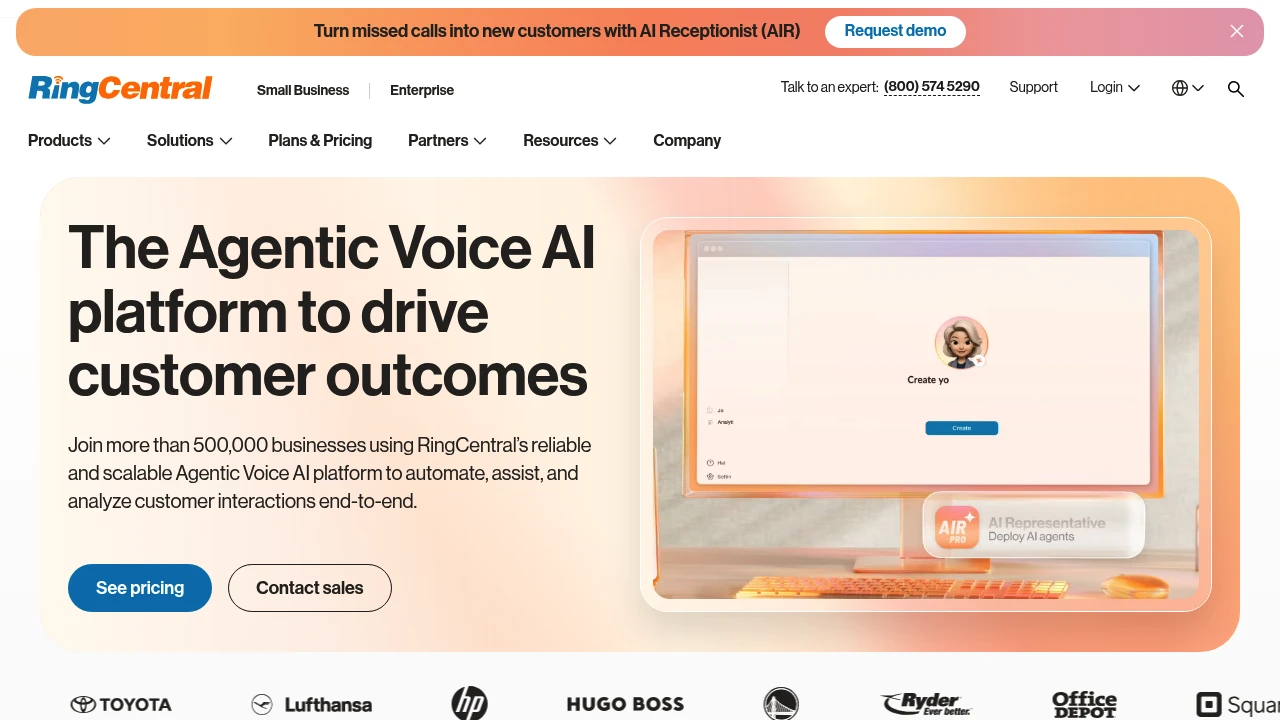
What is RingCentral
RingCentral is a cloud communications platform that bundles business phone, team messaging, video meetings, contact center capabilities, and AI-powered conversation tools into a single service. The platform targets organizations that need a unified communications-as-a-service (UCaaS) and contact-center-as-a-service (CCaaS) solution that can be deployed quickly across locations and scaled for hundreds or thousands of users.
RingCentral positions itself as an enterprise-capable product with features aimed at IT administrators (centralized management, integrations, directory sync), contact center managers (routing, quality management, real-time coaching), and business users (mobile and desktop apps, meetings, SMS). It includes tools for compliance, security, and global telephony coverage so organizations with distributed workforces and regulated industries can adopt cloud voice.
The product family includes modules often marketed as phone system / business phone, contact center (RingCX), video and events (RingVideo), and a set of AI capabilities (AI Receptionist, AI Conversation Expert, AVA virtual assistant). These modules can be purchased together or integrated with third-party systems via pre-built integrations and open APIs.
RingCentral is commonly used by small and medium businesses as well as larger enterprises; the company reports hundreds of thousands of customers and multi-country coverage, which supports multi-national deployments and centralized billing and support.
RingCentral features
RingCentral offers a broad set of features across voice, messaging, video, contact center, and AI. The platform is built to provide a consistent user experience across desktop, mobile, and web clients while exposing administrative controls for provisioning, policy enforcement, and analytics.
Key platform components include cloud telephony (call routing, auto attendants, call recording), team messaging and content sharing, high-definition video meetings with event hosting, a contact center module with omnichannel routing (voice, SMS, chat), and conversation intelligence that surfaces call summaries, coaching opportunities, and customer insights.
The platform emphasizes AI-driven automation: AI Receptionist for automated call handling and lead capture, AVA (AI Virtual Assistant) for note-taking and workflow suggestions, and AI Conversation Expert for conversation analytics and agent coaching. These features are intended to reduce manual effort, accelerate agent onboarding, and provide searchable records of customer interactions.
Administrators also get controls for security and compliance (role-based access, SSO, audit logging), integrations with CRM and productivity platforms, and an open developer platform for custom workflows and telephony integrations.
What does RingCentral do?
RingCentral provides cloud-hosted telephony services that replace on-premises PBX systems and SIP trunks. It routes inbound and outbound calls, supports direct inward dialing (DIDs), and supplies enterprise calling features such as hunt groups, call queues, and multi-site numbering.
For collaboration, RingCentral offers persistent messaging channels for teams, file sharing, and threaded conversations that link to meetings and phone calls. Its video service supports scheduled meetings, webinars, and larger virtual events with attendee management and analytics.
On the customer service side, RingCX (the contact center module) delivers omnichannel queuing, skills-based routing, interactive voice response (IVR), workforce management integrations, and AI-driven quality management to monitor and improve agent performance.
RingCentral also exposes APIs and pre-built integrations so data and events (call records, transcripts, presence) can be pushed to CRMs, ticketing systems, and analytics platforms for unified workflows and reporting.
RingCentral pricing
RingCentral offers flexible pricing tailored to different business needs, from small teams to global enterprises. Their pricing typically includes monthly and annual billing options with discounts for yearly commitments and multiple-seat purchases; for current detailed plan costs and any promotional rates, consult RingCentral's official pricing resources.
Typical customer purchases combine a core calling plan with optional add-ons (contact center licenses, advanced analytics, dedicated numbers, global numbers, and additional AI features). Organizations that need contact center features or advanced compliance often move to higher tiers or purchase separate contact-center bundles.
For IT and procurement teams, pricing considerations include: seat count, international dialing requirements, call recording or retention needs, CRM integrations, and whether a dedicated PSTN gateway or direct routing is required. RingCentral also offers enterprise contracts and custom quotes for large deployments with volume discounts and committed terms.
Visit their official pricing page for the most current information.
How much is RingCentral per month
RingCentral offers flexible monthly billing options designed for different team sizes and usage patterns. Monthly plans typically let you add or remove seats and scale telephony features quickly; contact-center and advanced AI modules are usually billed per agent or per seat and can significantly change the monthly cost profile.
When evaluating monthly costs, include PSTN usage (domestic and international minutes), SMS volume, conferencing minutes, and storage for recorded media. Many customers choose annual billing when possible because it usually reduces the effective monthly price.
For exact monthly rates and per-user breakdowns, check the company’s detailed plan comparison or contact RingCentral sales for an itemized quote.
How much is RingCentral per year
RingCentral offers annual billing options that generally provide savings compared with monthly rates. Annual billing is common for businesses that want predictable budgeting and often comes with a percentage discount relative to the month-to-month price.
Annual costs should be estimated by multiplying per-seat rates by the number of seats and adding recurring costs such as contact center agent licenses, premium numbers, and add-on modules. One-time setup or porting fees may also apply depending on migration needs.
For precise yearly totals and to calculate potential savings from annual commitments, review the company’s published plans or request a custom quote from RingCentral sales via their official pricing page.
How much is RingCentral in general
RingCentral pricing is designed to scale from single-office small businesses to multinational enterprises. The total cost range depends on the number of users, selected feature set (basic calling vs. full contact center and AI suite), and add-ons like international calling, recording retention, and integrations.
In general terms, expect base telephony seats to represent the core recurring cost and contact center or advanced AI modules to be additional line items. Large enterprises with specialized compliance needs or global PSTN requirements will see higher overall costs due to dedicated carrier services and support levels.
Visit their official pricing page for up-to-date plan comparisons and to request a tailored quote.
What is RingCentral used for
RingCentral is used to replace or modernize legacy telephony infrastructure with cloud-hosted voice services, while adding collaboration and contact-center capabilities. Organizations use it to provide a single phone number per employee that works across desk phones, laptops, and mobile devices, improving reachability and simplifying administration.
Customer service departments use RingCentral’s contact center products to route inquiries across voice, chat, and SMS, measure agent performance, and apply AI to surface call summaries and coaching opportunities. Sales teams often integrate RingCentral with CRMs to log interactions, automate follow-ups, and capture leads from inbound calls or texts.
IT departments use RingCentral for centralized user provisioning, policy enforcement, emergency calling (E911 and equivalent services in other countries), and detailed call analytics for capacity planning. The platform’s global coverage and carrier relationships also make it useful for multi-national deployments.
RingCentral is also used for events and webinars where teams need to host external audiences, record sessions, and provide attendee engagement tools. The combination of meetings, messaging, and phone in one package simplifies vendor management and reduces integration overhead.
Pros and cons of RingCentral
RingCentral provides a comprehensive set of communication tools, but organizations should evaluate trade-offs like cost, complexity, and vendor lock-in when adopting a full-suite UCaaS/CCaaS solution.
Pros:
- Broad feature set across voice, messaging, meetings, and contact center—useful for organizations that want a single vendor.
- AI features (AI Receptionist, AVA, conversation intelligence) that reduce manual work and provide searchable interaction data.
- Global telephony coverage and administrative controls for multi-site and multi-country deployments.
- Open APIs and extensive third-party integrations for CRM, collaboration, and ITSM platforms.
Cons:
- A comprehensive feature set can mean higher costs for organizations that need only basic calling or meetings.
- Contact center and advanced AI modules are typically add-ons with per-agent pricing that increases overall spend.
- Feature depth can create a learning curve for administrators and end users; some organizations require change management and training.
- Dependence on vendor for telephony and uptime means careful SLA and redundancy planning is necessary for mission-critical use cases.
When assessing RingCentral, consider total cost of ownership (seats + minutes + add-ons), required compliance certifications, and migration complexity from an existing PBX or contact center solution.
RingCentral free trial
RingCentral commonly offers time-limited free trials for new customers so they can evaluate calling, messaging, and meetings. Trials typically let administrators create user accounts, test call routing and auto attendants, and evaluate desktop and mobile clients without committing to an annual plan.
Free trials are useful for validating call quality, PSTN coverage in your target markets, and integration behavior with CRMs or directory services. They also provide a way to test contact center routing and basic analytics before purchasing agent licenses.
If you need extended evaluation or pilot deployments across multiple departments, contact RingCentral sales to request a trial extension or a sandbox environment. Larger pilots often require coordination to provision numbers and integrate with existing telephony or SIP trunks.
Is RingCentral free
RingCentral does not typically provide a perpetual free plan; it offers free trials and paid subscription tiers. Trial periods allow new users to evaluate the platform, but ongoing use requires a paid plan or an enterprise agreement.
For organizations that require a long-term no-cost solution, RingCentral’s model is focused on paid subscriptions; evaluate trial results and plan comparisons before committing. For up-to-date trial terms and availability, see RingCentral’s pricing and plans.
RingCentral API
RingCentral publishes APIs and SDKs to enable custom integrations and automation. The developer platform supports telephony events, messaging, meetings, presence, and recordings, enabling organizations to build custom workflows, CRM syncs, and data exports.
Common API use cases include click-to-dial from a CRM, automatic logging of calls and transcripts into support tickets, custom IVR flows, and building integrations that trigger outbound messages or follow-ups based on call outcomes. The developer site includes REST APIs, WebSocket events, and client SDKs for multiple languages.
Developers will also find documentation on authentication (OAuth), rate limits, and best practices for handling media and webhooks. For technical documentation, SDK downloads, and sandbox registration, visit RingCentral’s developer platform.
10 RingCentral alternatives
RingCentral competes in the UCaaS and CCaaS markets. Below are paid and open source alternatives to consider based on feature sets, pricing models, and deployment preferences.
Paid alternatives to RingCentral
- Zoom — Offers Zoom Phone, Meetings, and Zoom Contact Center; strong meeting capabilities and broad ecosystem integrations.
- Microsoft Teams — Part of Microsoft 365 with integrated calling, meetings, chat, and deep Office 365 integration and governance.
- Cisco Webex — Enterprise-grade collaboration with calling, meetings, and contact center offerings and strong security options.
- 8x8 — Cloud communications and contact center platform with a focus on global voice and analytics.
- Vonage — Offers cloud communications and contact center services with developer-friendly APIs and flexible deployment.
- Twilio — Programmable voice, messaging, and contact center building blocks for organizations that prefer developer-first, pay-as-you-go models.
- Google Workspace (Google Voice + Meet) — Provides integrated voice and meetings for organizations using Google Workspace, with simple management and G Suite integration.
Open source alternatives to RingCentral
- Asterisk — Widely used open source telephony engine for building PBX systems and custom call flows; requires self-hosting and telephony expertise.
- FreeSWITCH — Scalable telephony platform for building switch-based systems, conferencing, and media-handling applications.
- Jitsi — Open source video conferencing server and clients suitable for private hosting of meetings; less focused on telephony.
- BigBlueButton — Open source web conferencing tool designed for online learning with shared whiteboards and breakout rooms.
- Kamailio — SIP server for routing and load balancing SIP traffic; used as a carrier-grade component for custom telephony stacks.
Frequently asked questions about RingCentral
What is RingCentral used for?
RingCentral is used for unified communications and contact center operations. Organizations deploy it to replace on-premises phone systems with cloud telephony, run team messaging and meetings, and manage customer interactions through a contact center with omnichannel routing and conversation intelligence.
How does RingCentral pricing work?
RingCentral offers competitive pricing plans designed for different team sizes and feature requirements. Pricing typically includes per-seat charges for calling and additional per-agent fees for contact center capabilities, with optional add-ons for international calling, recording storage, and advanced AI features. For exact plan details, consult RingCentral’s official pricing page.
Does RingCentral integrate with Microsoft Teams?
Yes, RingCentral provides integrations with Microsoft Teams. Integrations enable click-to-dial from Teams, call routing, and synchronization of presence and contacts; specific integration features depend on the plan and any installed connectors or licenses.
Can RingCentral replace a traditional PBX?
Yes, RingCentral can replace an on-premises PBX with cloud telephony. It provides enterprise calling features such as hunt groups, auto attendants, call queues, and emergency calling, while removing the need to manage physical telephony hardware.
Is RingCentral secure?
RingCentral implements industry-standard security and compliance controls. The platform includes encryption in transit, role-based access controls, support for single sign-on, and enterprise compliance features; review RingCentral’s published security documentation for specific certifications and controls at their security center.
Why choose RingCentral over other UCaaS providers?
RingCentral offers a combined UCaaS and CCaaS product set with AI capabilities. Organizations that want a single vendor for calling, contact center, meetings, and AI-driven conversation intelligence may prefer RingCentral to reduce integration complexity and centralize vendor support.
When should I contact RingCentral sales?
Contact RingCentral sales when you need a tailored quote, enterprise terms, or assistance with a large deployment. Sales can provide volume discounts, porting assistance, and migration planning for multi-site rollouts or carrier integrations.
Where can I find RingCentral careers?
RingCentral publishes career opportunities on its corporate careers page. For current openings, locations, and hiring practices, see RingCentral’s careers portal and LinkedIn company page to review roles and apply.
What APIs does RingCentral offer?
RingCentral provides REST APIs, SDKs, and webhooks for telephony, messaging, meetings, and presence. Developers can build custom integrations, automate workflows, and stream telephony events to third-party systems using the RingCentral developer platform at developers.ringcentral.com.
How do I get support for RingCentral?
RingCentral offers support via documentation, chat, and paid support plans. Support levels vary by plan; enterprise customers can access dedicated account teams and higher SLAs. For troubleshooting and product documentation, consult RingCentral’s support site and knowledge base.
ringcentral careers
RingCentral hires across engineering, product, sales, customer success, and technical support roles to support a global communications platform. Job openings typically include positions for cloud engineers, software developers with VoIP/media experience, contact center specialists, and customer success managers who understand UCaaS/CCaaS deployments.
Candidates should expect interview cycles that include technical assessments for engineering roles and case-based discussions for customer-facing functions. RingCentral’s careers pages and recruiting communications often list benefits, remote work options, and the company’s global office locations.
For current positions and application instructions, visit RingCentral’s corporate careers site or their profiles on major job boards and professional networks.
ringcentral affiliate
RingCentral operates channel and partner programs that include resellers, managed service providers, and technology partners. The partner programs offer co-selling opportunities, referral fees, bundled service offerings, and technical enablement to help partners sell and integrate RingCentral solutions.
Affiliate or partner entrants typically complete partner onboarding, attend enablement training, and get access to partner portals for quoting, provisioning, and administering customer tenants. Incentives and margins vary by partner type and geographic region.
If you are interested in becoming a RingCentral partner or affiliate, consult RingCentral’s partner program pages for program tiers, requirements, and benefits documentation.
Where to find ringcentral reviews
Independent reviews of RingCentral are available on major software review platforms and industry analyst reports. Look for product reviews, customer testimonials, and user ratings on sites like G2, TrustRadius, and Gartner Peer Insights to see real-world feedback on reliability, call quality, and support.
Analyst reports and objective comparisons (for example, Gartner Magic Quadrant summaries) provide context on market positioning, feature breadth, and enterprise suitability. For product-specific details and customer case studies, RingCentral’s own site publishes use cases and customer success stories that complement third-party reviews.
When researching reviews, compare similar-sized organizations, industry verticals, and the specific modules (telephony vs contact center) to get apples-to-apples insights.

Similar to Ringcentral


