
Klaviyo
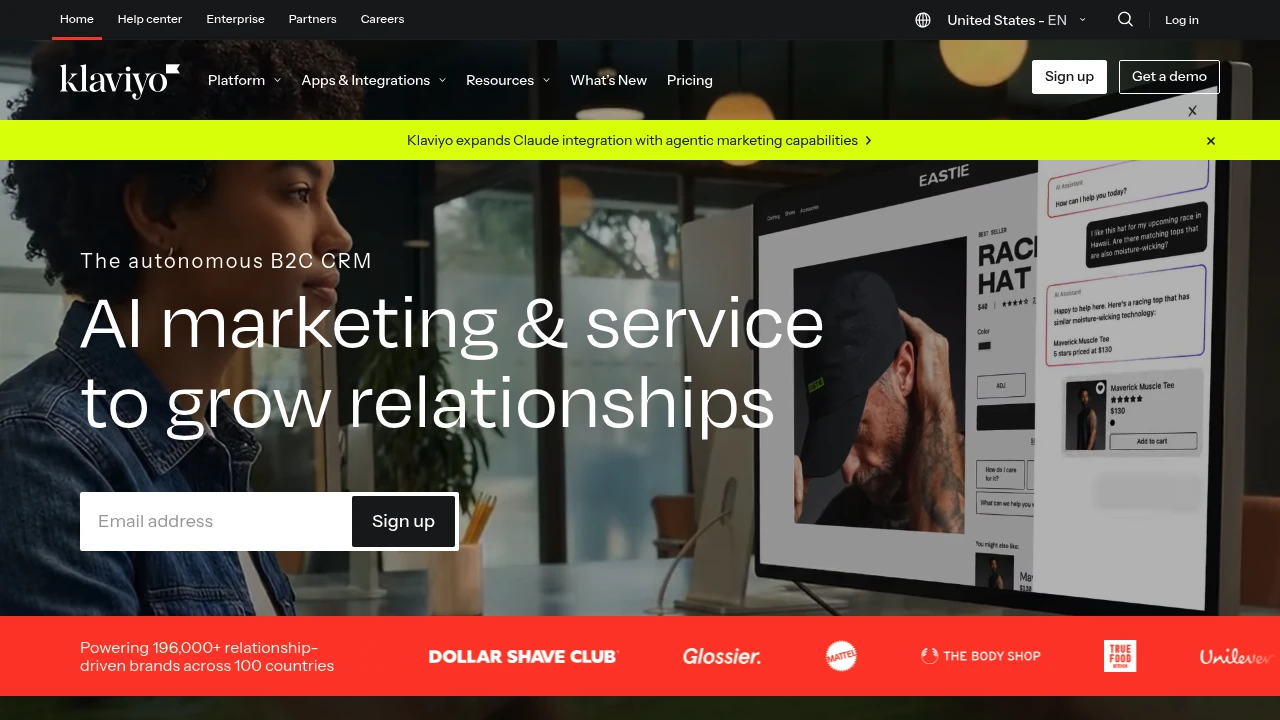
Klaviyo is a B2C customer relationship management platform that combines email marketing, SMS and messaging, customer data (CDP) capabilities, analytics, and AI agents to personalize acquisition, retention, and post-purchase experiences for ecommerce and direct-to-consumer brands.
What is Klaviyo
Klaviyo is a B2C CRM and marketing platform focused on unified customer data, automated messaging, and personalization across email, SMS, and messaging channels. It centralizes customer profiles and behavioral data so marketing, growth, and support teams can create targeted campaigns, automated flows, and analytics-driven reporting. Klaviyo emphasizes real-time data ingestion from ecommerce platforms, point-of-sale systems, and site events to enable segmentation and automation that respond to customer actions.
The platform positions itself as an AI-first product with native agent capabilities—K:AI Marketing Agent and K:AI Customer Agent—that assist with content generation, campaign optimization, and conversational support. These AI agents access a brand’s first-party data to generate personalized copy, recommend segments, and handle inbound messages across channels like WhatsApp and text.
Klaviyo is used by a wide range of direct-to-consumer and ecommerce businesses, from small online stores to mid-market retailers. It integrates with many ecommerce platforms and third-party systems so teams can leverage purchase history, browsing behavior, and other customer signals for more relevant messaging. For company metrics and adoption figures, see Klaviyo’s company information and platform overview on their site (Klaviyo’s company statistics).
Klaviyo features
What does Klaviyo do?
Klaviyo collects, unifies, and leverages customer data to run targeted marketing and service programs. It provides tools to design email campaigns and flows, send SMS and messaging, segment audiences, and measure results with native analytics. Core functionality includes:
- Centralized customer profiles that combine transactional, behavioral, and custom event data.
- Email and SMS campaign builders with templates, A/B testing, and automation flows for post-purchase, winback, cart abandonment, browse abandonment, and lifecycle messaging.
- AI-powered content generation and assistants for both marketing assets and customer conversations through K:AI agents.
- Multi-channel orchestration including email, SMS/RCS, WhatsApp, and web push where available.
- Analytics and attribution reporting that ties campaigns to revenue, conversion rates, and LTV.
Klaviyo also provides a range of platform features that support operations and governance:
- Data ingestion and connectors for ecommerce platforms, POS systems, CDPs, and custom APIs.
- Web and server-side tracking to capture events and custom properties for richer segmentation.
- Deliverability tools and reporting to manage sender reputation, bounce handling, and domain authentication.
- Template and asset libraries, plus a marketplace of integrations for inventory systems, analytics, and creative tools (see Klaviyo App Marketplace at Klaviyo’s integrations directory).
Beyond messaging, Klaviyo offers tools for customer service and experience: a Customer Hub, Helpdesk integration, and K:AI Customer Agent for conversational support that can surface product suggestions and automate answers 24/7. These capabilities make it possible to combine marketing and service interactions into consistent omnichannel experiences.
Klaviyo pricing
Klaviyo offers flexible pricing tailored to different business needs, from individual users to enterprise teams. Their pricing structure is primarily based on the number of active contacts and message volume (email sends and SMS credits), with add-ons for additional channels or advanced features. Billing options typically include monthly and annual plans, and Klaviyo provides discounts for annual commitments and tiered volume pricing for larger contact bases.
Klaviyo commonly provides a Free Plan for small lists and to let teams test core features before scaling; paid plans scale by contact band and add SMS credits or enhanced support levels. Because pricing varies by required contact capacity, SMS volume, and feature set (e.g., dedicated IP, advanced analytics, enterprise SLAs), many teams calculate expected monthly cost by estimating active contacts and monthly sends.
For the latest, detailed rates and examples by contact band, check Klaviyo’s current pricing options for enterprise tiers and invoice-level discounts. Visit their official pricing page for the most current information.
How much is Klaviyo per month
Klaviyo offers competitive pricing plans designed for different team sizes and usage patterns; monthly cost depends mainly on the active contact count and SMS volume. Small merchants often start on a lower-cost monthly band or the Free Plan while mid-market and enterprise customers move to paid tiers that bill per contact band and include additional features and support. Check Klaviyo’s current pricing options for accurate monthly examples and contact-based calculators.
How much is Klaviyo per year
Klaviyo offers annual billing options with discounts for customers who commit to a yearly plan; the precise savings depend on the contact tier and contract terms. Annual billing can reduce cost compared to month-to-month for teams with predictable growth and messaging volume. For exact yearly totals and savings percentages for specific contact volumes, see Klaviyo’s detailed pricing information.
How much is Klaviyo in general
Klaviyo pricing ranges from a free tier for very small lists to enterprise-level contracts that scale with active contacts, message volume, and included services like dedicated deliverability support. In general, expect pricing to reflect three variables: number of active contacts, monthly email sends (often unlimited in many bands), and SMS/MMS credits for text messaging. Consult Klaviyo’s current pricing options to run modelled scenarios against your expected contact counts.
What is Klaviyo used for
Klaviyo is used to automate and personalize customer communications across the lifecycle of an ecommerce customer: acquisition, onboarding, retention, and reactivation. Teams use Klaviyo to create automated flows—cart abandonment, browse abandonment, post-purchase follow-ups, replenishment reminders, and winback campaigns—that trigger based on specific customer behaviors.
Companies use Klaviyo to centralize first-party data and create richer segments for targeted promotions. Because the platform records purchase history, browsing signals, and custom events, marketers can produce highly tailored offers and conditional content that increase conversion rate and average order value.
Klaviyo is also used for customer service and conversational commerce. Its K:AI Customer Agent capability is designed to respond to inquiries, surface product suggestions, and handle common post-purchase questions across channels like email, SMS, and WhatsApp. This lets service interactions double as revenue opportunities during busy periods like BFCM (Black Friday/Cyber Monday).
Finally, product and analytics teams use Klaviyo’s reporting to measure the revenue impact of specific campaigns and flows, analyze attribution across channels, and identify friction points in the customer journey. The platform’s analytics help quantify ROI on email and SMS investments and inform channel mix decisions.
Pros and cons of Klaviyo
Klaviyo delivers significant strengths for ecommerce marketers, but it also has trade-offs organizations should consider.
Pros:
- Centralized customer profiles and behavior-driven segmentation enable highly personalized campaigns and improved targeting.
- Rich ecommerce integrations with platforms like Shopify and Magento simplify event tracking and data syncs, speeding up time to value.
- Multi-channel support (email, SMS, WhatsApp) plus AI agents provides a combined marketing-and-service workflow that can reduce tool sprawl.
- Strong analytics and revenue attribution tools help quantify the business impact of campaigns.
Cons:
- Pricing complexity: costs scale with active contacts and SMS usage, which can make costs rise quickly as a brand grows without careful contact hygiene.
- Advanced features and enterprise-grade support often require higher-tier plans or custom contracts, which may be less accessible to small teams.
- Campaign and deliverability best practices require ongoing management; teams with limited deliverability expertise may need outside help or managed services.
- While the platform focuses on B2C ecommerce, B2B use cases or organizations with very complex data models may need additional customization or integrations.
Choosing Klaviyo typically involves weighing its strong ecommerce-oriented feature set and analytics against cost scaling and the internal resources required to maintain deliverability, segmentation, and campaign performance.
Klaviyo free trial
Klaviyo typically provides a Free Plan or trial access designed to let small teams trial core features before committing to paid tiers. The free tier commonly supports a limited number of contacts and includes basic email and flow functionality so merchants can test core flows like welcome series and cart abandonment. This approach allows teams to validate integrations and initial automation with production data prior to scaling.
During a free trial or on the free plan, features such as advanced analytics, priority support, SMS credits, or enterprise features are usually gated behind paid tiers. Teams should use the trial period to validate data flows, confirm that event tracking and integrations (e.g., Shopify or other commerce platforms) are accurately capturing behavior, and to run a small number of campaigns to evaluate deliverability and engagement metrics.
To use the trial effectively:
- Import a small seed contact list or connect your ecommerce store to generate real events.
- Configure at least one automated flow (welcome or cart abandonment) to test triggers and personalization.
- Use Klaviyo’s reporting to measure open, click, and revenue metrics for initial campaigns.
For current trial limits and exact free-tier allowances, check Klaviyo’s current pricing options and documentation for onboarding steps.
Is Klaviyo free
Yes, Klaviyo offers a free tier that allows merchants to test core email and automation features with a limited contact count and basic functionality. The free tier is intended for startups and small lists to validate integrations and flows before scaling.
Paid plans are required when your active contact list or messaging volume exceeds the free tier limits or when you need additional SMS credits, advanced reporting, or enterprise-level support. For the exact limits and what the free tier includes, review Klaviyo’s current pricing options.
Klaviyo API
Klaviyo provides a RESTful API and webhooks for data ingestion, event submission, profile management, and campaign triggering. The API enables developers to push custom events, update customer properties, retrieve metrics, and integrate Klaviyo with internal systems or third-party tools that are not covered by native integrations.
Common API use cases include:
- Sending custom events from servers or backend services to power real-time personalization and triggers.
- Programmatically creating or updating profiles and segments for synchronization with CRM or ERP systems.
- Exporting metrics and campaign data for custom reporting or BI platforms.
- Building custom integrations where native connectors do not exist.
Klaviyo documents endpoints, authentication methods (API keys), rate limits, and SDKs in its developer documentation; see Klaviyo’s API documentation and developer guides for implementation details, sample requests, and best practices for secure API usage.
10 Klaviyo alternatives
Paid alternatives to Klaviyo
- Mailchimp — All-in-one marketing platform with email, automation, basic CRM features, landing pages, and ad management. Popular for small businesses and simple ecommerce use cases.
- Braze — Enterprise-focused customer engagement platform for cross-channel messaging with strong mobile and in-app capabilities, suitable for high-scale consumer brands.
- Iterable — Growth marketing platform with unified customer profiles, cross-channel orchestration, and experimentation for mid-market to enterprise teams.
- ActiveCampaign — Email marketing, marketing automation, and CRM features aimed at SMBs; stronger CRM automation than many basic email providers.
- HubSpot Marketing Hub — Part of a broader CRM and marketing platform with deep inbound marketing and CRM integrations; better for teams that want integrated sales and marketing workflows.
- Omnisend — Ecommerce-focused email and SMS platform with pre-built ecommerce automations and a simplified UI targeted at smaller merchants.
- SendGrid (Twilio SendGrid) — Email delivery service focused on high-volume sending and deliverability tooling; pairs well with custom systems and developer workflows.
Open source alternatives to Klaviyo
- Mautic — Open-source marketing automation that supports email campaigns, pipelines, and event tracking; requires infrastructure and maintenance but offers deep customization.
- Listmonk — Self-hosted newsletter and mailing list manager focused on performance and control over sending; suitable for teams that want full hosting control.
- Mailtrain — Open-source self-hosted newsletter application with audience segmentation, templates, and automation capabilities.
- OpenEMM — Open-source email marketing software offering campaign management and tracking; typically used by organizations willing to run and maintain their own servers.
Each alternative trades off between hosted convenience, feature depth, customization, and total cost of ownership. Paid platforms remove operational overhead but incur subscription costs; open-source solutions provide control but require hosting, deliverability management, and engineering resources.
Frequently asked questions about Klaviyo
What is Klaviyo used for?
Klaviyo is used for B2C email and SMS marketing and customer data management. It helps ecommerce and direct-to-consumer brands send automated lifecycle campaigns, segment audiences by behavior, and attribute revenue to campaigns using built-in analytics.
How does Klaviyo integrate with ecommerce platforms?
Klaviyo integrates directly with major ecommerce platforms via native connectors. Integrations (for platforms such as Shopify and Magento) sync orders, catalogs, and customer events in real time so you can trigger flows and personalize messages based on purchase and browsing behavior.
Does Klaviyo support SMS and WhatsApp messaging?
Yes, Klaviyo supports SMS and other messaging channels. The platform includes SMS/RCS capabilities and provisions for conversational channels like WhatsApp, with billing and credits managed alongside email sends.
Can Klaviyo personalize messages with first-party data?
Yes, Klaviyo personalizes communications using unified customer profiles. It combines purchase history, site events, and custom properties to populate dynamic content, recommend products, and tailor offers to individual customers.
Is Klaviyo suitable for small ecommerce shops?
Yes, Klaviyo is commonly used by small ecommerce shops and startups. There is typically a free tier and lower contact bands that let small merchants start with core automations before scaling to paid contact tiers as the list grows.
Why do teams choose Klaviyo over generic email tools?
Teams choose Klaviyo for its ecommerce-first features and CDP capabilities. Its deep integrations with commerce platforms, revenue attribution, and behavior-driven flows are designed specifically to increase customer lifetime value for DTC brands.
When should a company move from Klaviyo's free tier to a paid plan?
Companies usually upgrade when their active contact count or SMS volume exceeds free-tier limits or when they need advanced features. Upgrading is also common when teams require higher deliverability support, dedicated IPs, or enterprise SLAs.
Where can I find Klaviyo pricing and plan details?
Klaviyo publishes detailed pricing by contact band and message usage on their pricing page. For accurate quotes, contact Klaviyo sales or use their online pricing calculator to model expected monthly or annual costs (see Klaviyo’s current pricing options).
How secure is Klaviyo with customer data?
Klaviyo implements standard enterprise security controls and compliance features. They provide documentation on security practices, data handling, and compliance options; review Klaviyo’s security and compliance documentation for specifics on encryption, access controls, and certifications.
Does Klaviyo have an API for custom integrations?
Yes, Klaviyo provides an API and webhooks for custom integrations. Developers can push events, manage profiles, and retrieve analytics programmatically—see Klaviyo’s API documentation and developer guides for endpoint details and examples.
Klaviyo careers
Klaviyo maintains a public careers page listing roles across engineering, product, marketing, operations, and customer success. Job listings typically include remote and hybrid options and describe responsibilities, team structure, and hiring stages. For the most current openings and recruiting information, visit Klaviyo’s careers portal on their site.
Working at Klaviyo often appeals to candidates with ecommerce or data-driven marketing experience because the company builds tools specifically for consumer brands. Interview processes usually include practical exercises or portfolio review for technical and product roles; compensation and benefits are listed per role where applicable.
For recruiters and applicants, the careers page offers insight into culture, values, and diversity and inclusion initiatives. If you’re considering applying, prepare examples that demonstrate experience in growth marketing, data engineering, product design, or customer success in ecommerce contexts.
Klaviyo affiliate
Klaviyo runs partner programs that include agency partnerships, integration partners, and affiliate-style referral programs for consultants and technology partners. These programs typically offer co-marketing, training, and referrals or revenue-share structures for partner-driven customer acquisitions.
If you represent an agency or integration provider, review Klaviyo’s partner pages to understand certification requirements, partner tiers, and benefits. For direct affiliate or referral opportunities, contact Klaviyo’s partner team through their site to learn about program details and eligibility.
Where to find Klaviyo reviews
User reviews for Klaviyo are available across multiple software-review platforms and industry publications. Common sources include G2, Capterra, TrustRadius, and ecommerce community forums where merchants share hands-on feedback about deliverability, onboarding, and total cost of ownership. You can also find case studies and customer testimonials on Klaviyo’s site and in published customer interviews.
When reading reviews, compare feedback on onboarding experience, deliverability performance, support responsiveness, and cost at scale. For objective metrics and peer comparisons, consult aggregated review pages and independent analyses from marketing technology blogs.
Research notes:
- Source material provided in prompt includes product positioning, K:AI agents, Customer Hub, Helpdesk, 183,000+ brands claim, and marketplace references.
- Pricing is contact- and volume-based; exact monthly/yearly prices vary by contact band and SMS usage. Linked to Klaviyo’s official pricing page for current rates: https://www.klaviyo.com/pricing
- API and developer docs referenced via Klaviyo docs: https://www.klaviyo.com/docs
- Integrations and marketplace referenced: https://www.klaviyo.com/integrations
- Security and company stats referenced via Klaviyo company/security pages: https://www.klaviyo.com/company and https://www.klaviyo.com/security
- Alternatives list assembled from commonly compared platforms in the email/SMS/CDP space and known open-source marketing tools.

Similar to Klaviyo


