
Procurify
Purchase order and spend management software for procurement, finance, and operations teams to centralize purchasing, enforce approvals, and integrate spend data with ERP and accounting systems.
What is procurify
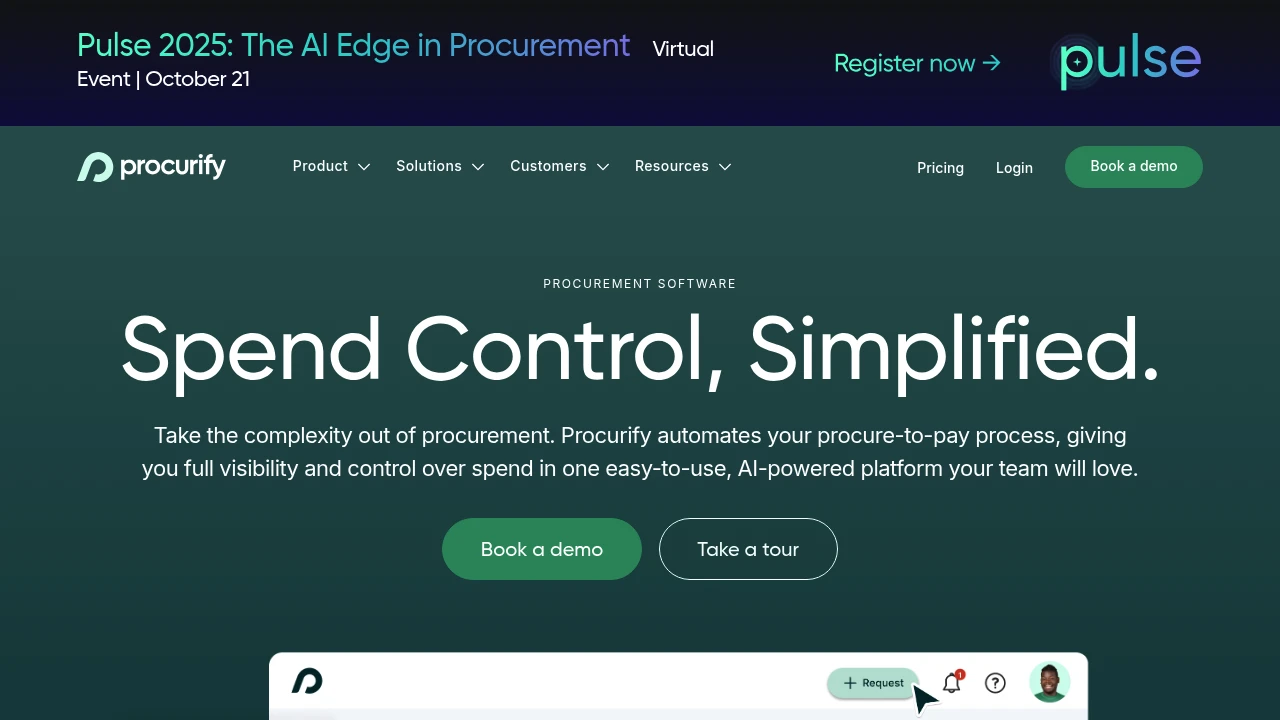
Procurify is a cloud-based procurement and spend management platform that centralizes purchasing, approvals, and supplier records for mid-market and enterprise organizations. It provides a purchase order (PO) workflow, requisitioning, budget controls, and reporting designed to reduce maverick spend and improve visibility into committed and actual spend. The product targets procurement teams, finance departments, operations managers, and decentralized purchasing stakeholders in distributed organizations.
Procurify is delivered as a multi-tenant SaaS application with web and mobile clients, role-based access controls, and integrations to common ERPs and accounting systems. Organizations use it to replace ad hoc purchase processes (email, spreadsheets) with governed workflows and an auditable trail from requisition through receipt and invoice reconciliation. The platform emphasizes ease of use for non-procurement staff while giving finance teams controls they can enforce across departments.
Administrators can configure approval chains, budget rules, and custom item catalogs while buyers and budget owners use Procurify to submit requests, create POs, and receive shipments. The centralization of requests and POs helps teams forecast spend, maintain compliance with procurement policies, and speed up the purchasing lifecycle.
Procurify features
What does procurify do?
Procurify provides purchase request submission, purchase order generation, approval workflows, receipt tracking, and basic invoice reconciliation. The platform converts a purchase request into a PO that can be emailed to suppliers, links receipts to POs for three-way matching, and stores all purchasing records for audit and reporting. It supports mobile request approvals so managers can approve orders on the go.
Key operational features include configurable approval chains, budget allocations that prevent overspend at department or project levels, centralized vendor and catalog management, and searchable purchase history. Users can create item catalogs with pricing, preferred suppliers, and GL account mappings to help standardize buying and speed up approvals.
On the reporting side, Procurify offers dashboards and exportable reports for committed (PO) and actual spend, approval cycle times, and supplier activity. Administrators can build custom reports to analyze spend by department, project, vendor, or account code and to reconcile monthly spend versus budgets.
Additional platform capabilities include role-based permissions, SSO/SAML authentication, audit logs, and multi-currency support for organizations buying internationally. The mobile apps for iOS and Android allow request submission, receipt capture (photo of invoice/packing slip), and approval workflows outside the office.
Procurify pricing
Procurify offers these pricing plans:
- Starter: $35/month per user (billed annually) — basic requisitions, approvals, PO generation, and mobile approvals suitable for small teams
- Professional: $55/month per user (billed annually) — additional automation, expanded reporting, vendor/catalog management, and integrations with accounting systems
- Enterprise: Custom pricing — advanced security (SSO, audit features), onboarding services, API access, and configurable enterprise-grade workflows
Many customers sign enterprise contracts that include implementation and support fees; Procurify also offers options for annual billing and volume discounts for large user counts. Check Procurify's pricing page for the latest tiers and enterprise options.
How much is procurify per month
Procurify starts at $35/month per user when billed annually for the Starter tier. Monthly billing is typically available for Professional and Enterprise plans but often at a higher effective rate; confirm billing cadence with sales for short-term commitments.
How much is procurify per year
Procurify costs $420/year per user for the Starter plan when billed annually (equivalent to $35/month per user). Professional and Enterprise subscriptions are typically billed annually and may be priced higher depending on features, seat counts, and included services such as onboarding or integration work.
How much is procurify in general
Procurify pricing ranges from $35/month per user to $100+/month per user. Small teams can start at the lower end for core requisition and PO functionality, while larger organizations with advanced procurement, ERP integrations, and enterprise support should expect higher per-user or per-organization costs. Implementation and integration fees are common for mid-market and enterprise customers and should be budgeted separately.
What is procurify used for
Procurify is used to centralize and standardize the purchasing process across distributed teams. Instead of routing purchase requests through email and spreadsheets, teams use Procurify to submit requests against budgets, route approvals automatically, and generate POs that are tracked through receipt and invoicing. This reduces manual errors, improves compliance with purchasing policies, and shortens approval cycle times.
Finance teams use Procurify to enforce budget controls and to get reliable committed spend data from active POs. That committed spend visibility improves forecast accuracy and helps finance leaders plan cash flow around supplier commitments. Procurement teams use the vendor and catalog features to promote preferred suppliers and negotiated pricing, helping organizations capture discounts and consolidate spend.
Operational teams use Procurify to speed up procurement for routine buys—IT purchases, facilities supplies, and project materials—without requiring finance to manually approve each request. Mobile approvals let managers handle requests quickly, which reduces delays in mission-critical purchasing.
Procurify is also used for auditability and compliance: every PO, approval, and receipt is logged and timestamped, making it easier to trace spend history during internal audits or external financial reviews. The platform’s reporting capabilities support month-end reconciliation and supplier performance analysis.
Pros and cons of procurify
Procurify offers a clear, user-friendly interface that lets non-procurement users create requests quickly while giving finance the controls they need. The approval workflows are flexible and the centralized PO/receipt record reduces duplicate or unauthorized spend. Its mobile apps and receipt capture features address common operational pain points for field teams.
On the integration side, Procurify provides connectors and APIs that let organizations sync purchase and invoice data with ERPs and accounting packages, which reduces manual reconciliation work. The platform also supports role-based access controls and SSO for enterprise security requirements.
Areas to evaluate carefully: larger enterprises with very complex procure-to-pay (P2P) needs may find Procurify’s built-in invoice automation and advanced supplier onboarding less feature-rich than full-suite procure-to-pay systems (e.g., Coupa or SAP Ariba). Organizations that require deep invoice matching, automated AP approvals, and supplier portals for invoice submission should validate those workflows during evaluation.
Implementation can require cross-functional effort — mapping GL codes, configuring approval matrices, and setting vendor catalogs. Procurify offers services to assist with onboarding, but teams should budget time and resources for configuration, testing, and change management.
Procurify free trial
Procurify commonly offers a trial or demo for new customers to evaluate core requisition and PO functionality. During a trial you can typically test request submission, approval routing, PO creation, and the basic reporting dashboard. Trials are useful for validating workflows and getting stakeholder buy-in before purchase.
Trial length and included features depend on current commercial offers; many vendors provide a 14–30 day trial or a guided product walkthrough with a solutions consultant. For a hands-on trial, plan to import a small set of vendors and item records and to set up one approval flow so end users can exercise the full request-to-PO lifecycle.
To confirm current trial availability and enrollment steps, review Procurify's signup and trial information on their official site or contact their sales team for a guided evaluation that can include a sandbox environment and sample data configuration.
Is procurify free
No, Procurify is not a free product for most organizations. The platform is sold on a subscription basis with Starter and Professional tiers and Enterprise contracts for larger deployments. There may be promotional trials or limited-feature evaluations, but ongoing use requires a paid subscription.
Procurify API
Procurify exposes a RESTful API and developer endpoints that allow customers to integrate procurement workflows with ERPs, accounting systems, and third-party applications. The API typically supports CRUD operations for core objects such as purchase requests, purchase orders, vendors, items, and receipts. Webhooks are available for event-driven integrations so external systems can react to approvals, PO creation, or receipt events in real time.
Authentication is commonly handled via OAuth2 or API keys depending on the integration model and account level. The API documentation provides endpoint details, request/response schemas, rate limits, and sample payloads for common integration patterns. For detailed developer reference and SDK guidance, consult the official Procurify API documentation.
Common integration use cases include:
- Syncing approved POs and receipts to ERPs like NetSuite or SAP
- Exporting committed spend to financial planning tools
- Automating supplier creation from vendor master files
- Triggering notifications or downstream workflows via webhooks
Procurify also supports integration via middleware vendors and iPaaS platforms like Zapier, Workato, or MuleSoft, which can speed up deployments without writing custom code. For enterprise-grade integrations, Procurify’s professional services can assist with API-driven implementations and data migrations.
10 Procurify alternatives
- Coupa — Comprehensive spend management and source-to-pay platform aimed at enterprise procurement, with advanced analytics and supplier management.
- SAP Ariba — Robust procurement and supplier network for large enterprises, strong in strategic sourcing and global supplier collaboration.
- Oracle Procurement Cloud — Enterprise procurement within the Oracle ERP suite with deep ERP-native integrations and complex P2P features.
- JAGGAER — Source-to-pay and supplier management platform that focuses on category management and procurement optimization.
- Basware — Procure-to-pay and invoice automation specialist with strong AP automation capabilities.
- Spendesk — Spend control platform oriented toward modern teams for card-based purchases, expense management, and approvals.
- Tipalti — Supplier payments and AP automation that complements procurement workflows with global payment capabilities.
- Tradogram — Cloud procurement and purchasing software for SMBs with PO, RFQ, and supplier management features.
- Zoho Inventory — Inventory and order management with procurement features for small businesses looking to combine inventory and purchasing.
- Procurify — Listed here for context as a procurement-first solution focused on PO workflow and spend visibility
Paid alternatives to Procurify
-
Coupa — Enterprise-grade spend management with advanced analytics and supplier engagement tools. Coupa is suitable where deep strategic sourcing and category management are priorities and where an organization needs broad-scale supplier collaboration.
-
SAP Ariba — Best for large enterprises that require a global supplier network, complex sourcing events, and tight integration with SAP back-end systems. Ariba’s marketplace and sourcing capabilities are mature for multinational procurement operations.
-
Oracle Procurement Cloud — Ideal for organizations already on Oracle ERP or seeking a tightly integrated procurement module within a full ERP suite. Offers advanced invoice processing and supply chain finance capabilities.
-
JAGGAER — Targets organizations with category management needs and complex supplier lifecycles; offers advanced sourcing, contract management, and supplier performance features.
-
Basware — Focuses on robust invoice automation and AP workflows; useful for finance teams prioritizing automated invoice capture and matching over simplified requisition-first workflows.
Open source alternatives to Procurify
-
Odoo — Open source ERP with procurement and purchase modules. Odoo supports purchase orders, vendor management, and basic approval rules and can be extended via community modules.
-
ERPNext — Full-featured open source ERP that includes buying, supplier management, and basic workflow automation. ERPNext works well for teams that want an integrated accounting and procurement stack without license fees.
-
OpenBoxes — Open source inventory and supply chain system oriented toward healthcare and NGOs; it includes procurement-related workflows and receiving features useful for organizations with constrained budgets.
Frequently asked questions about Procurify
What is Procurify used for?
Procurify is used for centralized procurement and purchase order management. It helps organizations replace email and spreadsheets with governed requisition-to-PO workflows, approval routing, and receipt tracking so finance and procurement can control spend and capture committed purchase obligations.
Does Procurify integrate with accounting systems like NetSuite and QuickBooks?
Yes, Procurify integrates with major accounting and ERP systems. Integrations typically include syncing approved purchase orders and receipts to systems like NetSuite, QuickBooks, and other general ledgers; integration method and depth vary by plan and implementation.
How much does Procurify cost per user?
Procurify starts at $35/month per user for the Starter plan when billed annually, with higher per-user pricing for Professional tiers and custom Enterprise agreements that include implementation services and advanced features.
Is there a free version of Procurify?
No, Procurify does not offer a permanently free tier for production use. The vendor provides trials or demos for evaluation, but ongoing use requires a paid subscription appropriate to the organization’s size and needs.
Can Procurify handle multi-currency purchases?
Yes, Procurify supports multi-currency transactions. The platform accommodates purchases in different currencies and records exchange rates, which is important for organizations buying internationally or with foreign suppliers.
Does Procurify provide mobile apps for approvals?
Yes, Procurify has mobile apps for iOS and Android. The mobile clients let users submit requests, capture receipts (photos), approve POs, and check the status of purchase requests while away from the desktop.
How secure is Procurify?
Procurify implements enterprise-grade security controls. The platform includes role-based permissions, SSO/SAML options, encrypted data in transit, and audit logs; customers with strict compliance needs should review Procurify’s security documentation and enterprise options for certifications and controls.
Can I automate approvals in Procurify?
Yes, Procurify supports configurable approval workflows and automated routing. Administrators can create multi-level approval matrices based on department, spend thresholds, or item categories to ensure purchases are routed to the appropriate approvers automatically.
Does Procurify support invoice matching and AP automation?
Yes, Procurify supports PO and receipt matching to help with invoice reconciliation. For advanced AP automation—such as full invoice capture, three-way matching at scale, and automatic payment runs—organizations should evaluate Procurify’s Professional or Enterprise options or pair Procurify with dedicated AP automation tooling.
What reporting capabilities does Procurify include?
Procurify includes dashboards and exportable reports for committed and actual spend. Users can analyze spend by vendor, department, project, or account code and export data for budgeting, month-end reconciliation, or deeper analysis in BI tools.
### Procurify careers
Procurify hires across product, engineering, customer success, sales, and marketing to support SaaS operations. Roles often emphasize experience in procurement, SaaS product development, cloud infrastructure, and customer implementation services. Prospective applicants should review the Procurify careers page and LinkedIn for current openings and role descriptions.
Procurify affiliate
Procurify partners with resellers, implementation partners, and technology integrators for regional sales and complex integrations. An affiliate or partner program helps consultancies and systems integrators deliver implementation services and integrations to mutual customers; contact Procurify’s partner team for program details.
Where to find Procurify reviews
Look for user reviews and ratings on software review sites and procurement technology communities. Useful sources include G2, Capterra, and TrustRadius where customers detail ease of use, onboarding experiences, integration quality, and ROI. Also review case studies and customer testimonials on Procurify’s website to see industry-specific deployments and outcomes.

Similar to Procurify


